MIL-DTL-15024: Complete Guide to Types A–L (2026)


The U.S. Department of Defense spends roughly $20.6 billion per year managing corrosion on military equipment (GAO-19-39). The Navy share alone runs about $8 billion a year, more than half of the total DoD figure (Materials Performance / AMPP). Identification plates are the small-component end of that problem. A military data plate that fails after five years on a 30-year hull forces re-inspection, re-stamping and a paper trail that nobody wants.
MIL-DTL-15024 is the Department of Defense performance specification that solves this for the marking itself. It defines exactly how identification labels, plates, tags and bands must be built, tested and applied so that part numbers, serial numbers and UID data remain legible across decades of saltwater, hydraulic fluid and UV exposure.
This guide covers the current revision G (2018), the differences from legacy revision F (1997) and the ten construction Types (A through L, with I and K intentionally omitted) so that a procurement specialist, design engineer or compliance reviewer can pick the right plate construction in one sitting.
The Department of Defense itself has stated the problem plainly:
“We need more training and education for every individual associated with corrosion prevention and control. We want to develop a constituency that leverages positive change.”Daniel Dunmire, Director, DoD Corrosion Policy and Oversight Office (NDIA Systems Engineering Division, June 2015).
That training-and-prevention posture is the role MIL-DTL-15024 plays at the small-component level: it forces the identification layer of every piece of military equipment to outlast the corrosion problem.
MIL-DTL-15024 is a Department of Defense performance specification that establishes the physical characteristics, material requirements and testing standards for identification devices including plates, tags and bands used to mark military equipment. These identification devices display critical information such as nomenclature, part numbers, serial numbers, voltage specifications, manufacturer data and safety warnings on electrical, electronic and mechanical military equipment.
The specification ensures that UID (Unique Item Identification, per MIL-STD-130) labels remain legible and intact throughout the operational life of equipment, regardless of environmental conditions. From aircraft instrument panels to naval vessel systems, from ground vehicle components to weapon systems, MIL-DTL-15024 governs how military assets are permanently identified.
Important: the current active specification is MIL-DTL-15024G, published March 3, 2018 (now 8 years in force as of 2026), which supersedes MIL-DTL-15024F (28 November 1997, superseded but still legally referenced in many active contracts). Many existing contracts and legacy equipment still reference revision F, so it pays to understand both versions.
Key differences between F and G:
When each version applies:
Commercial adoption: use revision G for current best practices.
New contracts (post-2018): should specify MIL-DTL-15024G.
Legacy contracts: may reference MIL-DTL-15024F. Continue using the specified version.
Replacement parts: match the version specified in original equipment documentation.
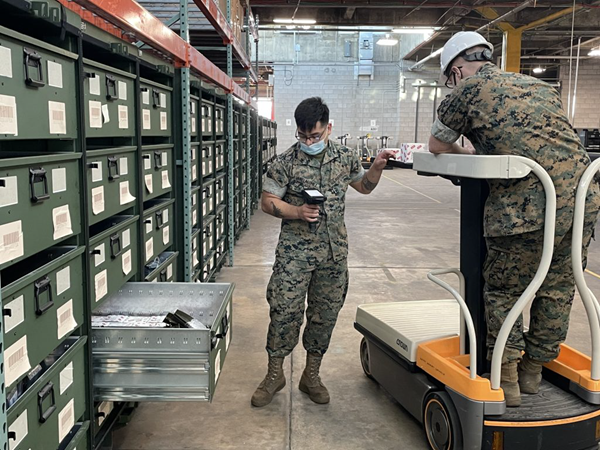
MIL-DTL-15024 defines ten types of identification devices (the spec deliberately skips I and removed K in revision G). Each type is optimized for specific materials, marking methods and environmental conditions.
| Type | Description | Material options | Marking method | Min. thickness | Best applications |
|---|---|---|---|---|---|
AType APremium |
Chemically etched or engraved plate | Brass, stainless steel, aluminum | Chemical etching (sunken or relief) | 0.03" | Outdoor equipment, high durability needs |
BType BMid |
Mechanically engraved plate | Brass, stainless steel, aluminum, plastic | Mechanical engraving with fill | 0.03" | Control panels, interior equipment |
CType CMid |
Stamped plate | Brass, stainless steel, aluminum | Stamped characters | 0.03" | Heavy equipment, rugged applications |
DType DPremium |
Cast plate | Bronze, brass | Cast raised characters | Varies | Heritage and traditional applications |
EType EInterior |
Printed plate | Brass, steel, aluminum, plastic | Screen, sublimation or digital print | 0.03" | Protected interior environments only |
FType FInterior |
Laminated plate | Non-metallic laminate | Printed between transparent layers | Varies | Interior panels, protected areas |
GType GMid |
Foils, vinyl or polyester labels | Adhesive-backed foil, vinyl or polyester | Integrated or surface printed | 0.012" (adhesive) | Flexible mounting, curved surfaces |
HType HPremium |
Photosensitive plate (Metalphoto®) | Anodized aluminum per GG-P-455 | Photographic process with silver compounds | 0.02" | Extreme durability, aerospace, marine |
JType JMid |
Stamped tag | Plastic, aluminum, stainless steel | Permanent stamping | 0.03" | Hanging identification, cable marking |
LType LPremium |
Laser-generated plate | Anodized aluminum, coated aluminum, phenolic plastic, stainless steel | Laser marking or engraving | 0.005"–0.0625" | High-precision, modern applications |
The specification deliberately skips Type I. Type K was removed entirely in revision G. Both are common questions worth answering directly.
Type I is not used because the letter “I” is too easily confused with the digit “1” in contract documents, drawings and stamped plates. Military identification standards have skipped “I” for decades for the same reason that maritime hull numbers, vehicle identification numbers and aircraft tail codes skip it. If you see “Type I” referenced in older documentation, it is either a typo or a non-MIL-DTL-15024 specification.
Type K (cable bands) was eliminated in the 2018 revision G update because cable band identification is better handled by Type G (adhesive-backed foils, vinyl or polyester) or by separate cable-marking specifications. Active contracts still calling out Type K should default to Type G unless the contracting officer specifies otherwise.
METALPHOTO OF CINCINNATI
Five quick questions. We map your answers to the specification’s Type A–L matrix and recommend the right plate construction.
For maximum durability (20+ years): Type H (photosensitive) or Type L (laser anodized aluminum).
For cost-effective solutions: Type B (mechanical engraving) or Type E (printing, interior only).
For corrosive environments: Type A (chemical etch), Type H (photosensitive) or Type L Class 1.
For curved or flexible mounting: Type G (adhesive foils, vinyl).
For traditional appearance: Type D (cast) or Type A (relief etched).
For hanging or cable identification: Type J (stamped tags).
Need help selecting the right type for your application? Contact our identification specialists for expert guidance on military specification labeling solutions.
Type J is the right answer when the identification has to hang from the part rather than mount onto it. Cable identification tags, removable asset tags for in-service equipment, valve tags and tag-along documentation tags are all Type J use cases.
Construction: plastic, aluminum or stainless steel, minimum 0.03″ thickness, with permanent stamped characters. The hole for the attachment ring or wire tie is part of the form factor. Type J tags are designed to be threaded onto cables, posts, valve handles or equipment loops.
Type J is the cheapest path to MIL-DTL-15024 compliance for inventory identification that does not need to live on a flat surface. It is also the only Type that explicitly contemplates a removable attachment.
Understanding compliance requirements is critical for manufacturers and procurement professionals working with MIL-DTL-15024. Unlike commercial standards, military specifications demand rigorous documentation, testing and quality control.
Character size standards:
Marking information: required data varies by application but typically includes nomenclature, part or model number, serial number, manufacturer identification code (CAGE), contract number, National Stock Number (NSN) when applicable (see DLA Federal Logistics Information System for current NSN assignments), Unique Identification (UID) per MIL-STD-130 when required, voltage and electrical specifications for electrical equipment, date of manufacture and safety warnings or operational instructions.
Color requirements: MIL-DTL-15024 specifies nine color styles using SAE AMS-STD-595 color standards.
| Style | Background color | Character color | Common use | Preview |
|---|---|---|---|---|
| Style I | WhiteSAE 37875 |
BlackSAE 37038 |
General equipment | SAMPLE |
| Style II | BlackSAE 37038 |
WhiteSAE 37875 |
Electronic equipment default. Used on most shipboard and avionic identification plates. | SAMPLE |
| Style III | BlackSAE 37038 |
NaturalAnodized aluminum |
Anodized aluminum | SAMPLE |
| Style IV | NaturalBare metal finish |
BlackSAE 37038 |
Natural metal finish | SAMPLE |
| Style V | Olive DrabSAE 24084 |
WhiteSAE 37875 |
Tactical equipment | SAMPLE |
| Style VI | RedSAE 21105 |
WhiteSAE 37875 |
Warning and caution labels | SAMPLE |
| Style VII | YellowSAE 23655 |
BlackSAE 37038 |
Attention and caution labels | SAMPLE |
| Style VIII | RedSAE 21105 |
NaturalBare metal characters |
High-visibility warnings | SAMPLE |
| Style IX | OrangeSAE 12197 |
NaturalBare metal characters |
Safety and emergency equipment | SAMPLE |
Material requirements: all materials must be fungus resistant (tested per ASTM G21), non-flammable, compatible with the substrate surface, capable of withstanding the same environmental conditions as the equipment and free from materials that promote corrosion.
No formal certification required. Unlike some military specifications, MIL-DTL-15024 does not require third-party certification. Manufacturers must demonstrate compliance through documentation and testing.
Required compliance documentation:
Common compliance mistakes to avoid:
Sampling procedures follow ANSI/ASQ Z1.4 (formerly MIL-STD-105). Inspection Level III applies for examination from each lot; Inspection Level S-4 applies for testing when testing is required. A lot is defined as all labels of the same type, style and size delivered at one time.
Major defects that result in lot rejection:
Testing frequency:
MIL-DTL-15024 labels must survive extreme conditions without degradation. The specification outlines rigorous testing protocols that vary by type and intended application.
1. Temperature cycling (MIL-STD-202, Method 107)
2. Weather resistance (ASTM D7869)
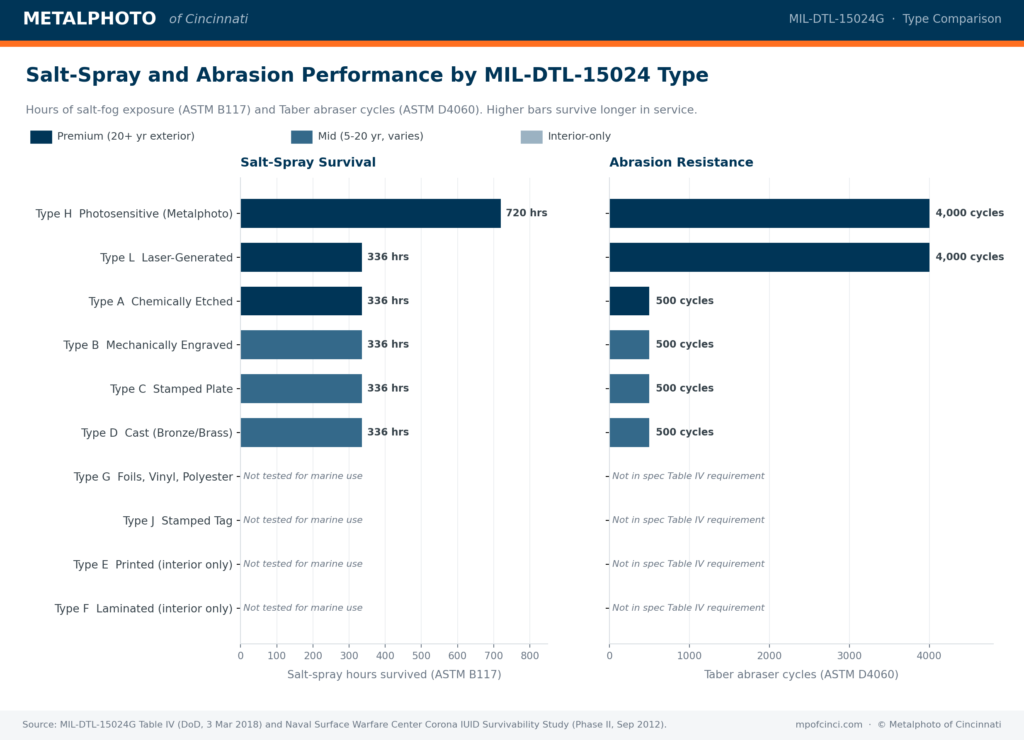
3. Abrasion resistance (ASTM D4060, Taber Abraser)
4. Salt spray corrosion (ASTM B117)
5. Fluid resistance (MIL-STD-810, Method 504)
6. Flammability (MIL-HDBK-454, Guideline 3)
7. Fungus resistance (ASTM G21, as above)
Not all types require all tests. The specification’s Table IV defines requirements:
Metallic materials:
Non-metallic materials:
Coatings and finishes:
Adhesives:
Recycled materials acceptable: recycled, recovered or environmentally preferable materials may be used if they meet or exceed all operational and maintenance requirements.
Chemical etching (Type A): photoresist masking followed by acid etching creates permanent sunken or relief characters. Depth minimum 0.003″ for filled plates. Provides excellent durability and chemical resistance.
Mechanical engraving (Type B): computer-controlled or pantograph engraving removes material to create characters. Minimum depth 0.008″ ensures durability. Filled with contrasting color for visibility.
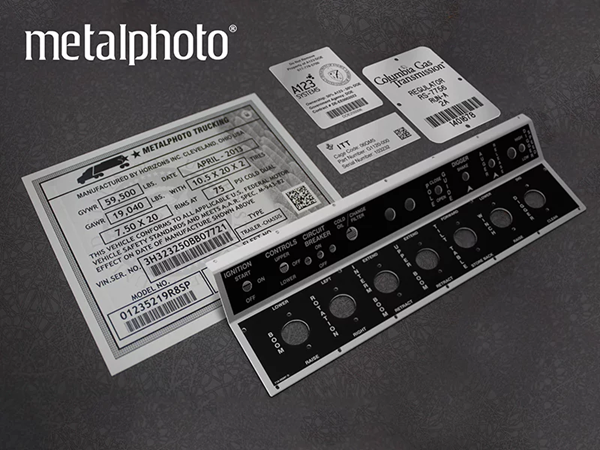
Photosensitive anodizing (Type H): the Metalphoto process integrates silver compounds into anodized aluminum through photographic exposure, creating images sealed beneath a clear anodic layer. The result is a plate that survives 1000°F exposure, 720-hour salt-spray testing per ASTM B117 and decades of outdoor weathering.
The most rigorous third-party test was conducted by the U.S. Naval Surface Warfare Center, Corona Division, in two phases (August 2011 and September 2012). Seventy-three label materials were submitted by manufacturers across industry; each was put through 38 laboratory tests simulating desert, marine and submarine operating environments. Metalphoto photosensitive anodized aluminum earned the highest possible score on 32 of the 33 tests for which it was evaluated, more top scores than any other label material in the study (IUID Environmental Survivability Testing Report Synopsis). That benchmark is why Type H is the default specification call-out for IUID label compliance across naval surface ships, the Abrams tank, the Bradley Fighting Vehicle and HMMWV families.
Laser marking (Type L): high-energy lasers create permanent marks by removing anodic coatings, ablating surface coatings, engraving into material or marking ceramic coatings. The four Type L classes correspond to four substrate types.
Type L is the only construction in the MIL-DTL-15024 family that splits into four distinct classes, each tied to a different substrate. Picking the right class is more important than picking Type L itself.
Class 1: laser ablates the anodic layer of black-anodized aluminum (per MIL-A-8625F Type II Class 2) to expose silver-colored aluminum beneath. Best for outdoor exposure, marine and decades of legibility. Tested to 4,000-cycle abrasion per Table IV.
Class 2: laser ablates a coated aluminum surface (typically a painted or powder-coated finish) to reveal contrasting substrate. Best for indoor industrial equipment where Class 1 is overkill but cost matters.
Class 3: laser engraves into phenolic plastic (per ASTM D709, Grade ES-1, ES-2 or ES-3). Best for lightweight non-conductive interior plates and panel labels.
Class 4: laser marks a ceramic-bonded coating on stainless steel. Best for extreme temperature environments where aluminum-based options would deform.
For a marine or outdoor application, Class 1 is almost always the right answer. For interior panels, Class 2 or Class 3 is more economical without compromising the spec.
Digital and screen printing (Type E): modern printing technologies allow full-color graphics and complex layouts. Must be overcoated with protective clear film. Limited to protected interior environments due to lower durability.
Ground systems:
Weapons systems:
Many commercial sectors adopt MIL-DTL-15024 standards for demanding applications:
Oil and gas: offshore platforms, refineries and pipelines use Type H plates for 20+ year identification in corrosive petrochemical environments.
Nuclear industry: reactor equipment labeling, safety-critical component identification where longevity and regulatory compliance are paramount.
Chemical processing: equipment exposed to aggressive chemicals, high temperatures and frequent cleaning.
Marine industry: commercial vessels, offshore installations, port equipment facing saltwater corrosion.
Heavy equipment: mining, construction and agricultural equipment requiring durable identification.
Utilities: power generation facilities, transmission equipment, substations where long-term identification reliability is critical.
Looking for military-specification identification solutions for your critical equipment? Explore MPC’s Metalphoto anodized aluminum nameplates meeting MIL-DTL-15024 Type H requirements for maximum durability.
MIL-DTL-15024 works in conjunction with other military standards to create a full identification system:
MIL-STD-130 (Identification Marking of U.S. Military Property): defines WHAT information must be marked and HOW it should be formatted, including Unique Identification (UID) requirements using 2D Data Matrix codes. MIL-DTL-15024 defines the physical label specifications that implement MIL-STD-130 requirements.
MIL-DTL-19834 (Metal Foil, Adhesive Backed): covers adhesive-backed metal foil identification plates, closely related to Type G labels in MIL-DTL-15024. Often used interchangeably depending on contract specifications.
GG-P-455 (Photographic, Photosensitive, Anodized Aluminum, linked above): the federal specification governing Type H photosensitive plates (Metalphoto). Defines the anodizing and photographic process requirements.
MIL-STD-1472 (Human Engineering): establishes legibility requirements including character sizing, spacing, contrast ratios and viewing distance considerations that affect label design.
MIL-STD-810 (Environmental Engineering): provides environmental test methods including Method 504 (fluid contamination) referenced in MIL-DTL-15024 testing requirements.
When preparing contracts, purchase orders or statements of work for MIL-DTL-15024 labels, specify:
Example specification language:
“Identification plates shall conform to MIL-DTL-15024G, Type H, Style II, Size 10. Plates shall include the following information in the specified format: [list data elements]. First Article Inspection is required. Testing per specification Table IV shall be performed on initial lot and every six months thereafter.”
Material selection: unless specifically mandated, contractors select materials that meet specification requirements for the intended environment and application.
Quality assurance: contractors must maintain quality systems capable of ensuring consistent compliance, with documented procedures for inspection, testing and nonconformance handling.
Documentation: contractors must provide Certificates of Conformance, test reports when applicable and maintain traceability records.
Design approval: when information plates (instructional or operational content) are required, contractors must submit proposed designs for customer approval before production.onal/operational content) are required, contractors must submit proposed designs for customer approval before production.
MIL-DTL-15024 represents decades of military engineering refinement, creating identification solutions that survive the harshest operational environments: carrier deck saltwater spray, Arctic cold, jet engine heat. Understanding the distinction between revision F (1997) and current revision G (2018) ensures your labels meet contract requirements for both legacy and new defense programs.
With ten distinct types and rigorous testing protocols including 336-hour salt spray exposure and 4,000-cycle abrasion testing, the specification guarantees that critical equipment information remains legible throughout the entire service life of military assets.
Success with MIL-DTL-15024 hinges on three fundamentals: selecting the appropriate type for your environmental conditions, maintaining full compliance documentation and working with experienced suppliers who understand both technical specifications and military qualification processes.
Whether you are marking aircraft instrumentation, naval systems, ground vehicles or adopting mil-spec standards for commercial applications in oil and gas or marine industries, this specification provides the proven framework for identification that withstands decades of service while supporting mission readiness, maintenance efficiency and operational safety.
Revision G (3 March 2018) superseded revision F (28 November 1997).
Key differences:
No formal third-party certification is required. However, manufacturers must demonstrate compliance through:
Government contracting officers and prime contractors may conduct audits or require additional proof of compliance capability before awarding contracts.
Start with environment:
Consult with experienced identification specialists when selecting types for critical applications. Contact MPC’s engineering team for application-specific recommendations.
No. The specification deliberately skips Type I because the letter “I” is too easily confused with the digit “1” in contract documents, drawings and stamped plates.
Type K was also removed entirely in the 2018 revision G update, with cable band identification now handled by Type G.
The most common rejection causes are:
Selecting the wrong Type for the environment (for example specifying Type E for outdoor use) is the single most expensive failure mode because every plate has to be remade.
Service life depends on type and environment.
Yes. ANSI/UL 969 covers commercial label durability for marking and labeling and UL 1310 covers nameplates for industrial control equipment.
ASTM standards like B117 (salt spray) and D4060 (abrasion) are used in both military and commercial specs.
The MIL-DTL-15024 framework is often adopted directly by oil and gas, nuclear and marine sectors because the spec is more rigorous than typical commercial alternatives.
For commercial applications not requiring military specification compliance but needing exceptional durability, consider MPC’s industrial-grade Metalphoto® nameplates using the same Type H photosensitive anodizing technology proven in military service.
At a minimum:
First Article Inspection adds a full dimensional, material and performance verification before production runs begin.
Our sales engineers are experts in automatic asset tracking, tagging and identification,a nd can answer all your questions. Get in touch now.
Lets Talk ›Enter your information and get a free guide of the key design considerations applicable to industrial control panel design, including schematics, relevant regulatory standards, and design considerations relating to every facet of effective control panel design for industrial equipment and machinery.